Stratego Rules
Stratego is a two-player game in which each side commands 40 hidden pieces and tries to capture the enemy Flag. This page explains the official Stratego rules from setup to the last move, then the details that cause most arguments at the table and the ways older editions differ. For a quicker overview, see the summary on the Stratego Game home page.
What you need to play Stratego
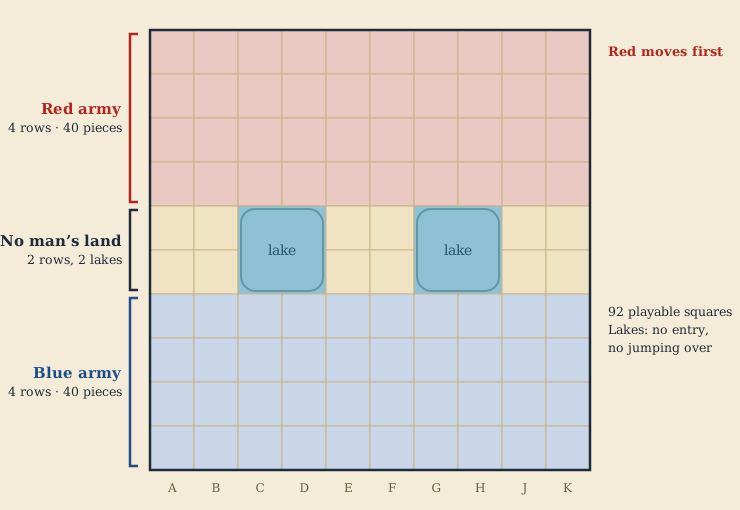
- The board: 10 by 10 squares. Two lakes of 2 by 2 squares sit in the two middle rows, so 92 squares can be played on.
- Two armies of 40 pieces, one red and one blue. Each piece shows its rank on one side only.
- A screen that stands across the middle of the board while both players set up.
The 40 Stratego pieces
Under the Stratego rules, higher numbers beat lower numbers. Three pieces break that rule: the Spy, the Bomb and the Miner.
| Rank | Piece | Per army |
|---|---|---|
| 10 | Marshal | 1 |
| 9 | General | 1 |
| 8 | Colonel | 2 |
| 7 | Major | 3 |
| 6 | Captain | 4 |
| 5 | Lieutenant | 4 |
| 4 | Sergeant | 4 |
| 3 | Miner | 5 |
| 2 | Scout | 8 |
| 1 | Spy | 1 |
| B | Bomb | 6 |
| F | Flag | 1 |
Setting up a Stratego game
- Choose colours. Draw lots for red and blue. Red will move first.
- Put up the screen so neither player can see the other's army.
- Place all 40 pieces on the four rows closest to you, one piece per square, ranks facing you and backs facing your opponent.
- Leave the two middle rows empty. Nobody may set up there.
- Remove the screen when both players are ready. Keep captured pieces beside the board where both players can see them.
How you arrange your army decides much of a Stratego game. Where the Flag sits, which pieces guard it and what stands in the front line are your first and most lasting decisions.
Moving pieces
Players take turns, and on your turn you do exactly one thing: move one piece. That move can go to an empty square or onto an enemy piece, which is an attack.
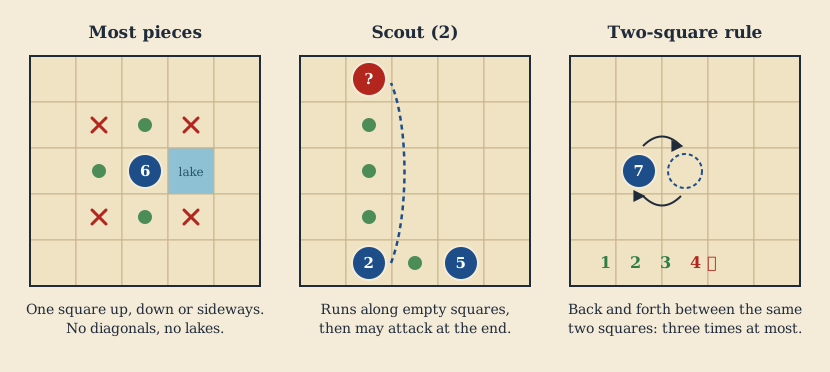
- One square at a time. A piece moves one square forward, backward, left or right.
- No diagonals and no jumping. A piece may not move diagonally or over another piece.
- Lakes are off limits. No piece may enter or cross a lake.
- One piece per square.
- Bombs and the Flag never move. They stay on their starting squares all game.
- Scouts are the exception. A Scout moves any number of empty squares in a straight line, like a rook in chess, but it cannot pass a lake or another piece.
Attacking
You attack by moving a piece onto an enemy piece directly in front of, behind or beside it. At the board, you tap the enemy piece with yours and name your rank; your opponent then names the rank of the defender.
| Result | What happens |
|---|---|
| Attacker has the higher rank | The defender is removed and the attacker moves onto its square |
| Defender has the higher rank | The attacker is removed and the defender stays where it is |
| Both have the same rank | Both pieces are removed |
You are never forced to attack, and two enemy pieces may stand side by side for as long as their owners like. Once a piece has fought, both players know its rank, so a winner that stays on the board is no longer hidden.
Special pieces
Scout (2). Scouts can attack at the end of a long run, which makes them the only pieces that strike from a distance. They are cheap, so they are the usual way to find out what an enemy piece is. A Scout can even capture the Flag or a Spy from across the board.
Spy (1). The Spy loses to every piece that attacks it. It has one weapon: when the Spy attacks the enemy Marshal, the Marshal is removed. If the Marshal attacks first, the Spy loses.
Bomb. Any piece that attacks a Bomb is removed and the Bomb stays. The only exception is the Miner.
Miner (3). A Miner that attacks a Bomb defuses it. The Bomb is removed and the Miner moves onto its square.
Flag. The Flag cannot move and can be captured by any piece that can move, including a Scout at the end of its run.
The two-square rule and chasing
To stop games from going round in circles, the Stratego rules limit two kinds of repetition:
- Two-square rule. You may not move a piece back and forth between the same two squares more than three times in a row. The player who started the shuttling has to stop first, even if that costs a piece.
- No endless chasing. You may not keep chasing one or more enemy pieces around the board. When a chase goes on across more than two squares, the chasing player must stop.
How to win at Stratego
- Capture the Flag. The first player to attack the enemy Flag wins.
- Leave your opponent without a move. If it is your opponent's turn and none of their pieces can move, you win. This happens when only Bombs and the Flag are left, or when the last movable pieces are walled in by Bombs.
The official Stratego rules do not describe draws. Players can still agree on one, and tournament games with a time limit can end when the time runs out.
How the Stratego rules differ between editions
Stratego has been printed since the 1940s, and the rules have shifted a little over the years. Before a game with an old set, agree on these points:
- Rank numbers. Early American editions numbered the ranks the other way round: the Marshal was 1, the Scout 9 and the Spy was marked S. The numbering flipped in 2000, and some classic editions still use the old labels.
- Scouts moving and striking. Sets produced since about 1970 let a Scout run and attack in the same turn. A few editions, such as Hasbro's Library edition, do not.
- The two-square limit. The current rules allow three back-and-forth moves. The German rulebook from 2000 allowed five.
- Stratego Duel. A short version with 10 pieces each: Flag, 2 Bombs, Marshal, General, 2 Miners, 2 Scouts and the Spy, set up anywhere on your four rows.
- Stratego Infiltrator. One Scout is swapped for an Infiltrator, a rank 1 piece that, once in enemy territory, can attack a piece one or two squares away by guessing its rank. A right guess removes the enemy piece, and the Infiltrator returns to its square either way.
- Other variants. Jumbo has also sold three- and four-player versions and sets with extra pieces such as the Cannon. Their rules are printed in those boxes.
Stratego rules at a glance
- Red moves first. One piece per turn.
- One square up, down or sideways. Scouts run in straight lines.
- Higher rank wins. Equal ranks both fall.
- The Spy beats the Marshal only when it attacks.
- Bombs beat every attacker except Miners.
- Bombs and the Flag never move.
- Win by taking the Flag or leaving your opponent without a move.